How Sylfirm X Works on the Body: Mechanism, Evidence, and Candidacy
Sylfirm X is a dual-mode radiofrequency (RF) microneedling platform cleared for use by licensed physicians in Canada and available at SkinArtMD in Burnaby. While most patients encounter Sylfirm X in the context of facial rejuvenation, its body applications — addressing skin laxity, striae distensae (stretch marks), and surface texture — represent one of the most clinically interesting expansions of the platform's utility.
This article is a science-focused companion to our treatment overview page. If you are already familiar with the basics and want to understand what is actually happening at the tissue level, this is for you.
Mechanism of Action: Two Modes, Two Biological Targets
Sylfirm X distinguishes itself from conventional RF microneedling through its dual electromagnetic delivery mode: Continuous Wave (CW) and Pulsed Wave (PW). Understanding the difference between these modes is essential to understanding what the platform can — and cannot — accomplish on body skin.
Continuous Wave (CW) Mode
In CW mode, the device delivers sustained radiofrequency energy through insulated microneedles to a precisely controlled dermal depth (typically 0.5–4.0 mm depending on anatomical site). The thermal energy heats collagen fibers to approximately 60–70°C, inducing immediate collagen fiber contraction (denaturation) and triggering a structured wound-healing response.
This thermal insult activates the classic three-phase remodeling cascade:
- Inflammatory phase (Days 0–3): Platelet degranulation releases PDGF (platelet-derived growth factor) and TGF-β1, recruiting fibroblasts to the microtrauma sites.
- Proliferative phase (Days 3–21): Fibroblasts synthesize Type I and Type III pro-collagen. Angiogenesis supports the newly forming extracellular matrix (ECM). Dermal thickness measurably increases on ultrasound imaging during this phase.
- Remodeling phase (Weeks 3–52): Collagen fibers reorganize along lines of mechanical tension, increasing tensile strength. Elastin synthesis contributes to improved skin firmness and elasticity.
For body skin concerns such as post-partum laxity, the extended remodeling phase — which can continue for up to 12 months after the final treatment session — is primarily responsible for the sustained skin tightening patients observe.
Pulsed Wave (PW) Mode
The PW mode is proprietary to Sylfirm X and represents a meaningful departure from standard RF microneedling architecture. Rather than delivering sustained energy, PW mode fires radiofrequency in precisely timed, brief pulses. This selective delivery allows the energy to target the basement membrane zone (BMZ) of abnormal microvasculature without producing the sustained bulk heating that characterizes CW delivery.
At the cellular level, the PW mode disrupts aberrant neovascularization — the dysfunctional, leaky capillary networks that underlie vascular lesions, certain pigmentation patterns, and the erythematous phase of active stretch marks. By selectively coagulating these abnormal vessels while preserving the epidermis and surrounding keratinocytes, PW mode reduces post-inflammatory hyperpigmentation (PIH) risk compared to ablative alternatives.
Why Insulated Needles Matter for Body Applications
Body skin differs meaningfully from facial skin: it is typically thicker, has lower sebaceous gland density, shows different vascular architecture, and exhibits slower wound-healing kinetics in certain zones. Crucially, body skin also encompasses a wide range of Fitzpatrick phototypes in a diverse patient population such as Burnaby and the Greater Vancouver area.
The insulated needle design ensures RF energy is deposited only at the needle tip — not along the shaft. This epidermal-sparing mechanism preserves melanocytes and surface keratinocytes regardless of skin tone, which is the primary reason Sylfirm X is considered safe across Fitzpatrick Types I–VI while ablative technologies carry substantially higher PIH risk in types IV–VI.
Clinical Evidence: What Peer-Reviewed Research Shows
Sylfirm X has accumulated published validation across several dermatologic body applications. Below is a summary of key evidence most relevant to body RF microneedling.
Skin Laxity and Collagen Remodeling
Kim et al., published in the Journal of Cosmetic Dermatology, evaluated RF microneedling for post-partum abdominal skin laxity. Histological analysis at 3 months post-final session demonstrated statistically significant increases in collagen density on Masson's trichrome staining. Blinded photographic assessment showed improvement in the majority of subjects, with patients presenting with moderate baseline laxity showing the most consistent outcomes. Importantly, the study documented progressive improvement beyond the final treatment session, consistent with the ongoing remodeling phase described above.
Striae Distensae: Histological Validation
Lee et al., reported in Lasers in Surgery and Medicine, assessed insulated-needle RF for stretch marks on the abdomen and thighs. Pre- and post-treatment biopsies demonstrated increased fibrillin-1 expression — a marker of elastic fiber regeneration — and normalization of collagen bundle orientation compared to untreated striae. Patient self-assessment scores showed significant improvement at 6-month follow-up. The study documented an important clinical distinction: striae rubra (active, erythematous stretch marks) responded more robustly than striae alba (mature, hypopigmented), likely because the vascular targeting of PW mode is more relevant to the active inflammatory component of newer lesions.
Dual-Mode RF and PIH Risk Reduction
Yoon et al., in Dermatologic Surgery, examined pulsed-wave RF specifically for vascular-associated dyspigmentation. The selective targeting of abnormal microvasculature without epidermal ablation was associated with substantially lower PIH rates compared to fractional ablative methods. For a clinic serving the diverse populations of Burnaby and Metro Vancouver — where Fitzpatrick types III–VI are common — this safety profile represents a clinically meaningful advantage.
Overall Safety Profile
Across published case series, the adverse event profile of insulated-needle RF microneedling is favorable. Transient erythema resolving within 24–72 hours is the most consistent finding. Occasional pinpoint bleeding at needle entry sites is normal and expected. Rare post-inflammatory pigment shift in higher Fitzpatrick types has been reported, but at rates significantly below ablative comparators. No reports of permanent scarring or systemic adverse events have been documented in the peer-reviewed literature when used within manufacturer-recommended parameters and under appropriate physician supervision.
Sylfirm X Body vs. Adjacent Technologies
Understanding where body RF microneedling fits in the broader therapeutic landscape helps set realistic expectations and informs combination treatment planning.
| Technology | Mechanism | Skin Type Safety | Downtime | Best For |
|---|---|---|---|---|
| Sylfirm X RF microneedling | Dual-wave RF via insulated needles | Fitzpatrick I–VI | 24–72 hours | Laxity, stretch marks, texture, body scarring |
| Fractional CO₂ laser | Ablative photothermal columns | Fitzpatrick I–III preferred | 5–14 days | Severe texture, deep scars |
| HIFU (focused ultrasound) | Acoustic energy at SMAS/fascia depth | Fitzpatrick I–VI | Minimal | Deep structural lift |
| Non-insulated RF microneedling | Bulk dermal heating | Fitzpatrick I–VI | 24–72 hours | Mild laxity, general texture |
| Topical retinoids (Rx) | Retinoid receptor agonism | All types | None | Mild striae, long-term maintenance |
Clinical decision note: Sylfirm X is not the right answer for every body concern. Patients with significant excess skin volume from major weight loss may require surgical consultation. Patients with very mild laxity and low treatment threshold may be better served by prescription topicals with adjunct energy therapy. The value of physician evaluation is precisely this type of individualized decision-making.
Book a Consultation to determine which approach best fits your specific skin type, concern severity, and treatment goals.
Candidate Evaluation: Who Benefits Most
At SkinArtMD, body RF microneedling candidacy is assessed by Dr. Sharon Fong, CPSBC-registered physician, integrating Fitzpatrick phototype classification, skin laxity grading using validated scales, a comprehensive treatment history review, and medication reconciliation. This physician-led evaluation is what distinguishes a medical aesthetics clinic from a non-physician provider setting.
Strong Candidates
- Striae distensae: Both striae rubra (active, erythematous) and striae alba (mature, hypopigmented). Rubra respond more robustly. Commonly treated areas include abdomen, thighs, buttocks, breasts, and upper arms.
- Post-partum or post-weight-loss body laxity: Patients with deflated, crepey skin on the abdomen, inner thighs, or upper arms following volume loss. Moderate laxity responds best; severe laxity may require combination approaches.
- Body acne scarring: Atrophic rolling and boxcar scars on the back and shoulders respond well. Ice-pick scars show limited improvement with any non-ablative modality.
- Surface texture concerns: Rough upper arm texture (keratosis pilaris-type), uneven thigh texture, and generalized skin roughness on larger body areas.
Candidates Requiring Modified Expectations
- Very advanced skin laxity may benefit from combination therapy — RF microneedling paired with biostimulator injectables (such as poly-L-lactic acid) for volumetric support alongside structural remodeling.
- Long-standing striae alba of many years' duration: partial improvement should be the expectation. Complete resolution is not a realistic outcome.
- Patients with documented keloid history on the chest or upper back: relative contraindication requiring detailed risk-benefit discussion with the treating physician.
Contraindications
- Active infection, open wounds, or active inflammatory skin condition (psoriasis, eczema) in the treatment zone
- Implanted electronic devices — pacemakers, implantable cardioverter-defibrillators — are an absolute contraindication to RF energy
- Pregnancy or active breastfeeding
- Isotretinoin use within the preceding 6 months (impaired wound healing and increased risk of adverse scarring)
- Active anticoagulation or blood-thinning medications — evaluated case-by-case; increased bruising risk
- True keloid formation history — relative contraindication; physician judgment required
Many patients who visit SkinArtMD in Burnaby have previously been told they are not candidates for laser treatment because of their skin tone. Sylfirm X's epidermal-sparing insulated needle design frequently makes it an appropriate option in these cases, though individual physician assessment remains mandatory.
Book a Consultation for an individual physician assessment before pursuing body RF microneedling.
Treatment Protocol: Step-by-Step
Pre-treatment preparation:
- Avoid sun exposure and self-tanning for 2 weeks prior
- Discontinue topical retinoids and AHAs 5–7 days before treatment
- Pause NSAIDs or non-essential blood-thinning supplements 3–5 days prior (if medically safe to do so)
- Arrive with clean, product-free skin at the treatment site
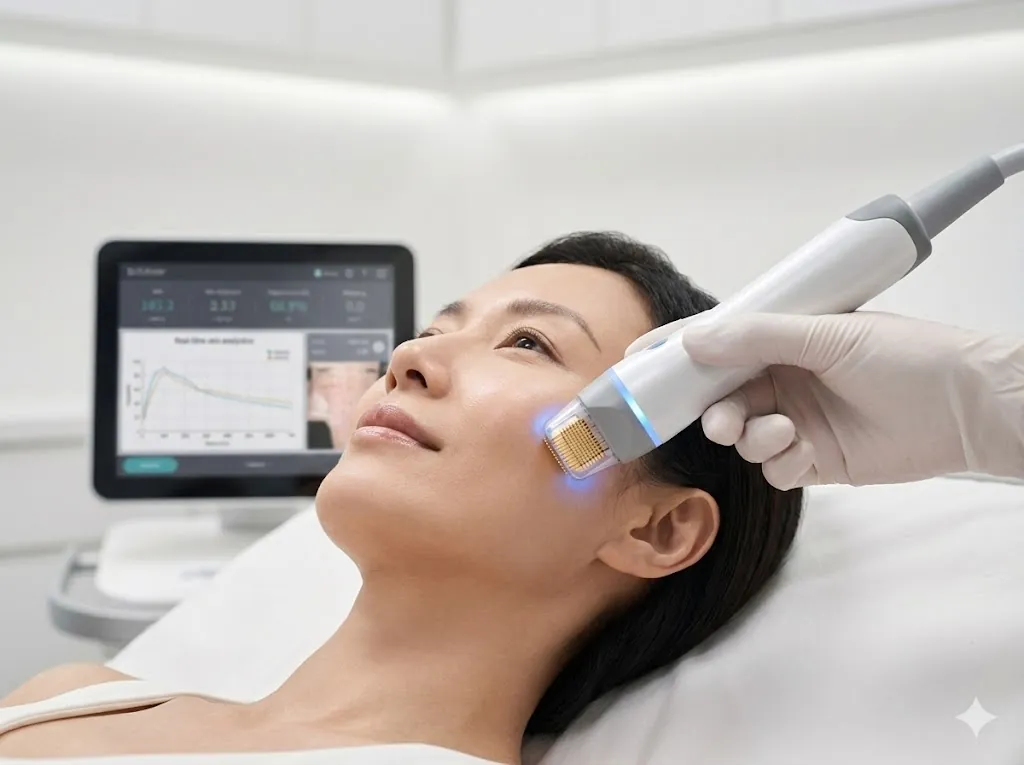
During the session: Topical numbing cream is applied for 30–45 minutes before treatment begins. The Sylfirm X handpiece is applied in a systematic grid pattern across the treatment area. Needle depth (0.5 to 4.0 mm) and energy level are calibrated per anatomical zone: shallower passes for thinner skin (inner arm, décolleté) and deeper for the abdomen and thighs. The treating physician selects CW, PW, or a combination approach based on the primary pathology. A body session typically takes 45–75 minutes depending on area size.
Post-treatment care:
- Erythema and mild edema are expected and typically resolve within 24–72 hours
- Avoid heat exposure — hot tubs, saunas, intense cardiovascular exercise — for 48 hours
- Apply SPF 30+ to treated areas with sun exposure during the recovery and remodeling period
- Resume retinoids after 5–7 days
- Visible texture improvement may begin at 4–6 weeks; collagen remodeling and full skin tightening results continue to develop through 3–6 months post-final session
Typical series: 3–4 sessions spaced 4–6 weeks apart, with maintenance sessions every 6–12 months to sustain collagen upregulation.
Limitations: Setting Honest Expectations
RF microneedling is a tissue-remodeling technology that works with the body's intrinsic biology. It does not remove excess skin, dissolve fat, or replicate surgical outcomes.
What Sylfirm X Body cannot do:
- Replace surgical abdominoplasty or body contouring procedures for significant skin excess or volume
- Completely resolve long-standing striae alba
- Provide surgical-equivalent structural lift for severe laxity
- Produce full results from a single treatment session — collagen remodeling is cumulative and biological
Patients who come to SkinArtMD often tell us they appreciate candor about what a treatment can and cannot accomplish. We document progress with photography at each visit so that the gradual improvement — which can be difficult to perceive day-to-day — is visible over the course of a treatment series.
Why Choose SkinArtMD for Sylfirm X Body?
Physician-led care: Every Sylfirm X Body treatment is preceded by a physician assessment. Dr. Sharon Fong's medical training, aesthetic specialization, and CPSBC registration means your protocol is built on clinical judgment — not upselling.
Body-specific expertise: Body skin is not facial skin. Our team understands the parameter differences required for abdominal versus thigh versus upper arm applications, and has the clinical experience to calibrate accordingly.
Safe for diverse skin tones: Burnaby and the Greater Vancouver area have one of the most ethnically diverse populations in Canada. Sylfirm X's epidermal-sparing mechanism makes it one of the most broadly applicable body remodeling tools we have for Fitzpatrick types I–VI.
Bilingual consultations: Our team offers consultations in both English and Mandarin (普通话). Many of our patients prefer discussing sensitive aesthetic concerns in Chinese — we make that possible without compromise.
Personalized protocols: Where appropriate, Dr. Fong may combine Sylfirm X Body with complementary modalities — prescription topicals, biostimulator injectables, or complementary energy devices — to optimize outcomes for complex concerns.
Frequently Asked Questions
How many Sylfirm X Body sessions will I need? Most body applications — skin laxity, stretch marks — require a series of 3–4 sessions spaced 4–6 weeks apart. Individual response varies based on laxity severity, stretch mark type (rubra vs. alba), and the size of the treatment area. Dr. Fong will recommend a specific protocol following your physician consultation.
Is the treatment painful? Topical numbing cream is applied before every session. Most patients describe the sensation during treatment as mild pressure with occasional brief stinging on deeper energy passes. Discomfort is well tolerated without sedation in the vast majority of patients.
When will I see results? Initial texture and tone improvement may be visible at 4–6 weeks. Collagen remodeling continues for up to 12 months after the final session; peak improvement is typically observed at 3–6 months post-treatment.
Is Sylfirm X safe for darker skin tones? Yes. The insulated needle design spares the epidermis from bulk heating, making Sylfirm X appropriate for Fitzpatrick types I–VI. Post-inflammatory hyperpigmentation risk is significantly lower than with ablative laser technologies, which is a meaningful advantage for the diverse patient population we serve in Burnaby and Metro Vancouver.
How does Sylfirm X Body differ from regular RF microneedling? Sylfirm X's proprietary pulsed-wave (PW) mode adds selective vascular and basement membrane targeting beyond what standard RF microneedling platforms deliver. This expands its clinical utility to vascular-associated conditions and stretch marks with an active erythematous component, and reduces collateral epidermal injury.
Is Sylfirm X cleared by Health Canada? Sylfirm X is a Health Canada-cleared device used by licensed physicians in Canada. All treatments at SkinArtMD are performed under physician supervision consistent with CPSBC standards of practice.
What is the downtime after a body treatment? Erythema and mild swelling are typical for 24–72 hours post-session. Most patients return to normal daily activities the following day. Heat exposure, intense exercise, and direct UV exposure to treated areas should be avoided for 48 hours.
Next Steps
If you have been researching Sylfirm X Body for skin laxity, stretch marks, or body texture concerns, the most productive next step is a physician consultation where Dr. Fong can assess your skin directly, review your treatment history, and recommend a protocol matched to your specific goals — not a generic package based on a checklist.
Ready to See What Sylfirm X Body Can Do for You?
Our medical team at SkinArtMD in Burnaby is ready to create your personalized treatment plan. Book your complimentary consultation today — available in English and Chinese.
This article is for educational purposes only and does not constitute medical advice. Please consult with a qualified healthcare professional before undergoing any treatment.